


Types of OTPW supports
The type of OTPW supports utilized depend on the methods used to suspend the cable:
- intermediate supports, where the wires are fixed via suspension clamp,
- Anchor type supports, serve to provide tension to the wires. These supports are fixed via tension clamps.
The distance between the supports of overhead power lines is called the span, and the distance between anchor type supports is called the anchor site.
Intersections with facilities such as railroads require the use of anchor type supports. Angular supports are installed on corners where the wires can either be suspended via suspension or tension clamps. Thus, the two main types of support can classified by their purpose.
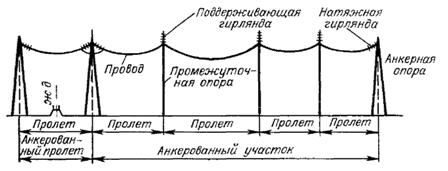 Illustration of an anchor supported overhead line
Intermediate straight supports are installed on straight power line. On the intermediate supports with suspended wires, insulators are fixed in vertically hanging supporting bundles. On intermediate supports, the pin insulators are fixed with a wire. In both cases, the intermediate supports stabilize the structure from horizontal forces such as those caused by wind as well as vertical forces brought on by the weight of the wire and insulator.
The areas where the wires are uninterrupted precieve lower horizontal forces from tension loads on the wires and cables in the direction of the line and can therefore be made lighter than other types of supports. However, to ensure reliable operation of the line intermediate supports must still be able to withstand vertical forces acting on the line.
At angles of rotation of over 20 °, the weight acting on the support increases significantly. Therefore, intermediate angular supports are used for angles up to 10 - 20 ° while anchor type supports are used at areas with larger angles of rotation.
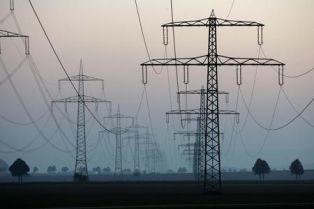
Intermediate support OW
Anchoring support. On lines with suspended insulators, wires are fixed by tension clamp bundles. These bundles are a continuation of the wire and transfer load onto the support. On the power lines with pin insulators, the insulators are fixed to the anchor supports via strengthened knots or special clamps that ensure complete transfer of tension from wires the wires onto the support.
When installing anchor supports on the straight sections of the power line, horizontal longitudinal loads are balanced by the cables, similar to intermediate supports, i.e, only transferred horizontal and vertical loads are precieved.
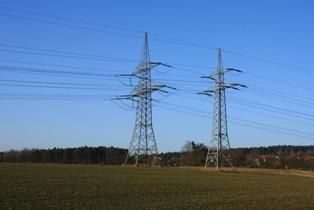
Anchor type support TW
If necessary, the wires can be pulled with varying tension at either side, in which case the anchor support will also support the difference in tension between the wires. In this case, besides the horizontal transverse and vertical loads, the anchor support will also percieve horizontal longitudinal forces. When installing anchor supports at the corners (points of rotation in the power line), anchor angular supports precieve the transverse tension in the wires and cables.
Dead-end supports are mounted on the ends of the line. These supports terminate the wire onto the portals substations. Dead end supports percieve only unilateral tension running down the terminating wires.
In addition to these types supports; the following types of support are also used: transposition supports, which serving to change the order of the wires on the pylons and junction supports to carry out branches from the main line as well as over river crossings and water areas, etc.
The main type of support used for OTPWs are intermediate supports, which constitute around 85 -90% of the total supports in the power grid.
By design the implementation supports can be divided into free-standing and guy- towers. Guy-towers are usually made of steel cables. Supports made from wood, concrete and aluminium are also used.